
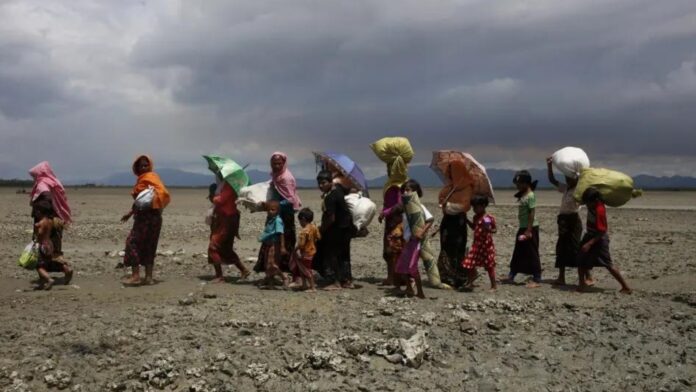
Image source: hrw
Seven years after hundreds of thousands of Rohingya fled persecution and violence in Myanmar, conflict continues in Rakhine State, located on the country’s west coast, resulting in an increase in casualties and displacement.
On the seventh anniversary of the forced mass displacement of the Rohingya and other communities on August 25, UN Secretary-General António Guterres called for an end to the violence and full protection for civilians across Myanmar. In a tweet on X (formerly Twitter) on August 24, 2024, Guterres described Myanmar as mired in “a brutal civil conflict.”
UN High Commissioner for Human Rights Volker Türk also warned that thousands of civilians in Rakhine State have been forced to flee on foot as Arakan Army separatists continue to mobilize in areas that offer little safe haven.
Human Rights Watch reported on August 22, 2024, that Rohingya Muslims in Myanmar are facing the most serious threats since 2017, when the Myanmar military conducted a comprehensive campaign of massacres, rape, and arson in northern Rakhine State.
On the seventh anniversary of the Rohingya crisis, Amnesty International highlighted that the escalation of attacks against the Rohingya in Rakhine State bears horrific parallels to the atrocities committed in August 2017.
On August 25, 2017, Myanmar security forces launched a systematic, large-scale attack on Rohingya villages following deadly assaults on police stations by the Arakan Rohingya Salvation Army (ARSA). It is important to note that “Arakan” is another name for Rakhine State.
Rohingya residents who fled the violence in 2017 joined refugees already in Bangladesh from previous waves of displacement. Together, they total nearly one million displaced individuals, according to Amnesty, or approximately 700,000 according to UN statistics.
In late April 2024, the Arakan opposition army began burning Rohingya villages east of Buthidaung Township. Satellite imagery and thermal anomaly data analyzed by Human Rights Watch reveal that more than 40 villages in Pothidaung Township were partially or completely destroyed by fire between April 24 and May 21, 2024. This destruction has devastated thousands of buildings across the area, including predominantly Rohingya neighborhoods in the town center. Human Rights Watch concluded that the pattern of destruction caused by fires throughout Buthidaung suggests that these attacks were deliberate.
Since August 5, 2024, reports circulating on social media and local media have indicated that the Arakan Army has conducted attacks on villages near Myanmar’s border with Bangladesh. Images have surfaced showing casualties along the Nav River, with unconfirmed CNN reports estimating about 200 people killed, alongside accounts of sexual violence, arson, and the displacement of thousands of civilians.
The killings of ethnic minorities based on their religion in Myanmar violate international law. The United Nations Declaration on the Rights of Persons Belonging to National or Ethnic, Religious, and Linguistic Minorities outlines a list of rights enjoyed by individuals belonging to minorities, including the right to enjoy their own cultures, the right to profess and practice their religions, and the right to use their own languages.
Same Justice Human Rights emphasizes the necessity of protecting individuals belonging to national and religious minorities, safeguarding them from civil, political, economic, and cultural violations based on discrimination, racism, and exclusion. The organization also stresses the importance of protecting individuals exposed to enforced disappearance, which violates international humanitarian law.

