
Image source: Wikimedia
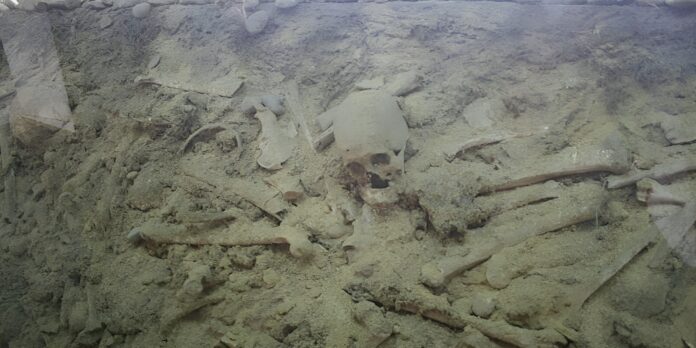
Since the fall of the Syrian regime, searches and investigations into the fate of the missing and forcibly disappeared have revealed the grim reality endured by Syrians. A large number of mass graves containing unidentified bodies have been uncovered, reflecting the severe violations committed against Syrians during the rule of the Assad family.
Since the fall of Bashar al-Assad’s regime (former Syrian president) on December 8, 2024, local and international teams have been working to document and locate mass graves in Syria. These sites are believed to serve as conclusive evidence of the previous regime’s mass executions of civilians.
The International Commission on Missing Persons (ICMP), based in The Hague, obtained data indicating the existence of 66 mass graves yet to be excavated in Syria. Over 150,000 people are considered missing, while the commission has collected information from more than 76,200 Syrian relatives reporting over 28,200 missing individuals.
Scattered Discoveries of Mass Graves
On December 17, 2024, Moaz Mustafa, head of the Syrian Emergency Task Force, told Reuters about discovering a mass grave containing at least 100,000 bodies of individuals killed by the previous regime in the town of Al-Qutayfah, 40 kilometers from the capital, Damascus.
Mustafa also confirmed the discovery of four other mass graves outside Damascus, containing the bodies of Syrian citizens, as well as Americans, Britons, and other foreigners.
On December 19, 2024, the Association of Detainees and the Missing in Sednaya Prison reported that its team visited the mass grave site in Al-Qutayfah, where eyewitnesses confirmed that the previous regime, in cooperation with Russia, bulldozed the grave between 2018 and 2020.
The association noted that the grave’s excavation aimed to “erase evidence of crimes committed by the previous regime and conceal critical proof of its severe human rights violations.” Witnesses informed the association that the site had been converted into a military radar base, raising serious concerns about the fate of thousands of victims buried there.
In December 17, 2024, Syrian Civil Defense teams exhumed the remains of seven bodies following a report about an open grave in an unwooded, fenced area near the city of Adra in eastern rural Damascus. The site featured trench-like excavations covered with concrete layers.
On December 16, 2024, Civil Defense teams uncovered 21 unidentified and unburied bodies along the road to Damascus International Airport in eastern rural Damascus.
The same day, Syrians found a mass grave on farmland west of Izraa in rural Daraa, southern Syria. The farm, once controlled by a militia affiliated with the regime’s Military Security Branch, contained 31 bodies, including women and children.
On December 14, 2024, Syrians observed about 150 deep pits in the Al-Husseiniyah area of rural Damascus, behind the Conference Palace. These pits, each 20 meters deep, reportedly contained about 75,000 bodies.
مقطع في غاية الأهمية:
— قتيبة ياسين (@k7ybnd99) December 14, 2024
ماذا يوجد هنا؟
150 مقبرة جماعية تحوي نحو 75 ألف جثمان معتقل موجودة في منطقة واحدة، هي منطقة الحسينية بريف دمشق خلف قصر المؤتمرات، كل حفرة بعمق 20 متر، يتم دفن جثامين المعتقلين على دفعات فوق بعضهم، يتم دفن أول حمولة تصل بالبرادات ويردم فوقه التراب، ثم تصل… pic.twitter.com/WyCCFoRIUE
On December 11–12, 2024, Human Rights Watch visited the site of the “Tadamon Massacre” in the Tadamon neighborhood south of Damascus. The organization reported discovering numerous human remains at the site of the April 2013 massacre, along with scattered remains throughout the neighborhood.
Calls to Protect Evidence
On January 15, 2024, the ICMP called for the protection of evidence at prisons, mass detention centers, and secret burial sites upon their discovery. The commission emphasized that the fall of the previous regime presents a “critical opportunity” to address the missing persons crisis and advance justice for victims and their families.
The recent events in #Syria present a critical opportunity to address the issue of the missing and advance #justice for victims and their families. It is essential to safeguard evidence from prisons, mass detention facilities, and clandestine burial sites as they are discovered.… pic.twitter.com/sOdf6RskBe
— ICMP (@TheICMP) December 15, 2024
On January 16, 2024, Human Rights Watch urged the protection of mass graves in Syria and the initiation of investigations. After examining a mass grave site in Damascus, the organization described Tadamon as a “scene of a mass crime,” suggesting the site had been used for mass executions.
On January 17, 2024, the United Nations called on Syria’s interim authorities to protect evidence that could aid in achieving justice and accountability.
Hani Magali, a member of the UN Independent International Commission of Inquiry on Syria, stressed that “preserving evidence” is paramount at this stage, as its tampering could render it unusable in court.
Robert Beaty, head of the International, Impartial, and Independent Mechanism (IIIM) for Syria, emphasized that current access to evidence of grave human rights violations brings accountability closer than ever provided the evidence is preserved.
Calls for Cooperation and Accountability
In a December 19, 2024 statement, Syrian Civil Defense called on Syrian authorities and media outlets to take responsibility in respecting and protecting mass graves from tampering. The organization decried ongoing dangerous and unprofessional interference with grave sites, including haphazard exhumation efforts.
بيان مناشدة من الدفاع المدني السوري بخصوص المقابر الجماعية وضرورة حمايتها
— الدفاع المدني السوري (@SyriaCivilDefe) December 19, 2024
لقراءة البيان كاملاً: https://t.co/3Hr9cgPkr8#الخوذ_البيضاء #سوريا #سوريا_الآن pic.twitter.com/XXdEqsp4L1
Such actions, the organization stated, violate the dignity of victims and their families, harm crime scene integrity, and hinder efforts to achieve justice.
On December 10, 2024, the ICMP emphasized the importance of cooperation among all “stakeholders” to uncover the fate of Syria’s missing persons. The commission advocated the use of genetic sciences and database technology within a new Syrian legislative framework, supported by both local and international authorities.
Systematic Extermination
The 2017 “Human Slaughterhouse” report by Amnesty International documented how Syrian authorities under Bashar al-Assad conducted systematic killings, torture, enforced disappearances, mass hangings, and large-scale executions at Sednaya Military Prison. These acts amounted to crimes against humanity.
The report, published on February 7, 2017, detailed a state-sanctioned campaign of extrajudicial executions, with groups of up to 50 detainees hanged weekly between 2011 and 2015. Over five years, approximately 13,000 people, primarily civilians believed to oppose the government, were secretly hanged at Sednaya.
Legal Pursuits
The IIIM was established in 2016 by a UN General Assembly resolution to collect, preserve, and analyze evidence supporting judicial investigations of international crimes in Syria since March 2011. These include war crimes, crimes against humanity, and genocide.
Robert Beaty noted that interconnected crime scenes across Syria, now accessible, present an opportunity to uncover evidence and determine the fate of countless unlawfully detained individuals.
Despite the Syrian government’s refusal to acknowledge the mechanism, the IIIM has amassed 283 terabytes of data and responded to over 400 requests for assistance from 16 judicial authorities, providing evidence and analysis in more than half of these cases.
Urgent Calls for Justice
The discovery of mass graves underscores severe violations of international humanitarian and human rights law. Extrajudicial executions, torture, and enforced disappearances constitute crimes against humanity under Article 7 of the Rome Statute of the International Criminal Court.
The organization “Same Justice” emphasizes that war crimes are not subject to a statute of limitations, per the Convention on the Non-Applicability of Statutory Limitations to War Crimes and Crimes Against Humanity. The organization urges swift action to protect official documents, identify perpetrators, and investigate all mass graves and cases of enforced disappearance.
Holding perpetrators accountable, it stresses, is essential to ensuring justice for victims and their families.

