
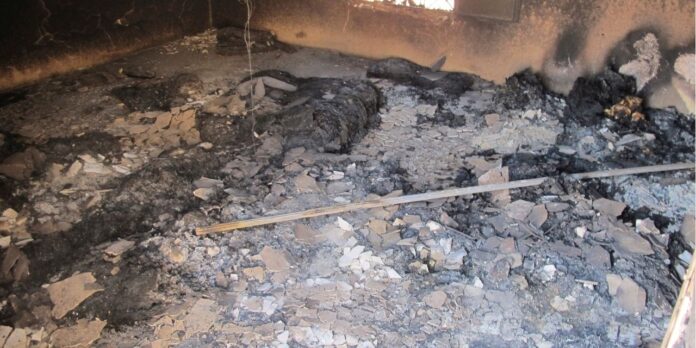
“They thought I was dead and left me before moving on to kill the rest of the village residents,” Abu Al-Abed recounted to Same Justice, describing his survival from the Al-Qubeir massacre.
Abu Al-Abed an alias used for personal security reasons is one of the survivors of the massacre that occurred in the village of Al-Qubeir in western Hama, Syria, on June 6, 2012.
In his testimony to Same Justice, Abu Al-Abed stated that regime forces entered the village and targeted everyone—men, women, and children. He described how they beat him using their hands and feet until he fell to the ground, bleeding from his mouth and nose. Thinking he was dead, they left him and moved on to burn other homes. He hid in a sheep pen until the massacre ended.
Abu Al-Abed, who lost several siblings in the massacre, confirmed that regime forces killed some victims by burning them and others with bladed weapons.
Following the massacre, the village was completely abandoned for several years as the remaining residents fled, fearing further attacks. However, some families, mostly widowed women, eventually returned and resettled in the village, according to Abu Al-Abed.
On the 12th anniversary of the massacre, Germany’s Special Envoy to Syria, Stefan Schneck, stated on his X platform account, “Today, we remember the Al-Qubeir massacre of 2012, which claimed the lives of dozens of innocent civilians.”
Schneck reaffirmed Germany’s solidarity with the victims’ families and its support for all efforts to achieve justice, accountability, and a peaceful resolution in Syria, ensuring such atrocities never occur again.
What Happened in Al-Qubeir?
Dozens of civilians, including women and children, were killed by regime forces in the village of Al-Qubeir in western Hama on June 6, 2012.
Three regime tanks, military Zil trucks, and six white buses moved toward the village, accompanied by riot-control vehicles marked “Anti-Riot” and several cars carrying individuals in military uniforms armed primarily with Kalashnikov rifles and PKS machine guns.
Civilian cars accompanied the military forces, carrying individuals in civilian clothing armed with sticks, knives, handguns, and Kalashnikov rifles. The assault began around 1:30 PM after the forces surrounded the village from the north, east, and west. After the operation concluded, the regime attempted to conceal evidence and hide the bodies.
The village consisted of 18 households, mostly extended relatives living close to each other, working in farming and herding. According to Abu Al-Abed, the massacre claimed between 50 and 100 lives, with an estimated 70 people, including women and children, killed.
The Syrian Regime’s Account of the Massacre
The Syrian regime denied allegations of its forces committing the massacre in Al-Qubeir, labeling the accusations as “completely baseless.”
Through state media, the regime accused an “armed terrorist group” of perpetrating the “heinous crime,” asserting that its forces had responded to residents’ calls for protection, leading to clashes with the group, during which members of the “terrorist group” were killed and their weapons seized.
International Observers and the Incident
The massacre coincided with the presence of the United Nations’ international observer team in Syria. However, the regime barred the observers from accessing the area until June 8, 2012.
General Robert Mood stated that UN observers were stopped at Syrian army checkpoints and turned away, with local civilians also blocking some patrols in the vicinity.
The UN Secretary-General at the time, Ban Ki-moon, condemned the massacre, calling it “horrific, revolting, and an unspeakable atrocity,” and described the Syrian regime as having “lost its humanity and legitimacy.”
UN spokesperson Susan Ghosheh reported that observers could smell the stench of bodies and see dismembered remains in and around the village.
The organization Same Justice has called for the prosecution of all those responsible for the Al-Qubeir massacre and other crimes committed against the Syrian people during the years of war, regardless of the perpetrators. The organization considers the events in Hama a “war crime” and underscores that war crimes do not expire under international law, as outlined in the first article of the Convention on the Non-Applicability of Statutory Limitations to War Crimes and Crimes Against Humanity.

