
Source of Picture: syacd
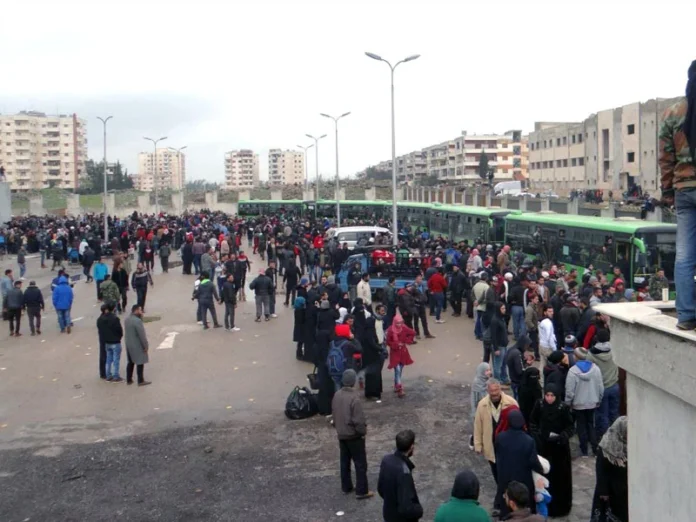
On May 7, 2014, the province of Homs in central Syria witnessed the departure of the first batch of what were dubbed as “opposition fighters” from their city, marking the beginning of a series of forced displacement of civilians that affected several Syrian cities, with the latest being in 2018.
About 2,400 people, including around 900 fighters, were evacuated in three batches from the old neighborhoods in central Homs to the northern countryside of Homs, as part of an agreement sponsored and supervised by the United Nations.
A United Nations team of four cars revealed the route from Homs to Dar Al-Kabira in the northern countryside of Homs, where the green buses used by the regime to transport opposition fighters were headed.
“The ceasefire agreement in Homs went into effect on May 2, 2014, based on an agreement between opposition fighters and the Syrian regime. This agreement allowed for the evacuation of fighters with their light individual weapons in exchange for aid entering the besieged towns of Nubl and Zahraa in the countryside of Aleppo (northern Syria), which were surrounded by opposition fighters.
The agreement came after battles that lasted for about three years, resulting in the destruction of most of the old neighborhoods in Homs. Syrians shared videos on social media documenting the evacuation operations and the departure of civilians and fighters from neighborhoods in Homs, except for the al-Waer neighborhood located outside of old Homs. Its residents were displaced in December 2015 under UN sponsorship towards the countryside of Idlib, where opposition forces are in control”.
“After the displacement of the residents of the old city of Homs to the northern countryside, a series of forced displacements began affecting several cities and towns in Syria, all sponsored by either Russia or Iran. The most prominent of these displacements include:
• The city of Daraya in August 2016
• The city of Aleppo in December 2016
• The Four Towns Agreement (Zabadani-Madaya, Kafraya-Al-Foua) in April 2017
• The countryside of Damascus in April 2018
• The province of Daraa in July 2018
According to the Human Rights Law, forced eviction is defined as the permanent or temporary removal of individuals, families, and/or local communities from their homes and/or land they occupy, against their will and without providing appropriate forms of legal protection or other forms of protection, and without access to protection.
The INEE (Inter-Agency Network for Education in Emergencies) defines forced displacement as the deportation of populations by coercion, which can result from conflict due to persecution, torture, or other human rights violations, or due to poverty or natural disasters. The element of choice and coercion may intersect, but in the case of refugees and other displaced persons, compelling circumstances are the determinant.
Forced displacement of civilians may constitute a “war crime”, and the Geneva Conventions of 1949 prohibit forced collective or individual transfers of persons, or their deportation from their territories to the territory of another state, regardless of the reasons, except in cases where it protects them from armed conflicts.
Forced displacement, according to the norms of the International Criminal Court, is considered a crime against humanity, and it is considered within the category of genocide crimes, as it results in forcibly transferring civilians and their children to other groups and areas with the aim of causing their total or partial destruction.
On this occasion, the organization “Same Justice” emphasizes the necessity of providing the opportunity for all forcibly displaced persons to return to their homes voluntarily, without restriction, obstacle, or condition, while providing a safe environment for them, including holding accountable those involved in war crimes and bringing them to justice.

